
Mental Health 101
Introduction
Risk and protective factors are central to understanding resilience in youth mental health.


RESILIENCE is commonly defined as the ability to adapt positively or “bounce back” in the face of adversity, trauma, or significant stress.
Rather than viewing resilience as a fixed personality trait, contemporary research conceptualizes it as a dynamic process influenced by multiple interacting factors across individual, relational, and environmental systems.
Key Concepts
RISK FACTORS are conditions or variables associated with a higher likelihood of negative mental health outcomes. Ex.
Trauma Exposure
Chronic Stress
Poverty
Family Conflict
Social Isolation
Resilience develops when protective factors interact with and offset the impact of risk factors.
Protective factors can be:
INTERNAL - Ex. coping skills, self-efficacy (one’s belief in their ability to succeed), problem-solving abilities
Categories
Now that we have introduced the concepts of risk and protective factors within a resilience framework, let’s examine each category more closely. Understanding how these factors operate individually and collectively will help you identify opportunities for intervention, prevention, and support in youth-serving settings.
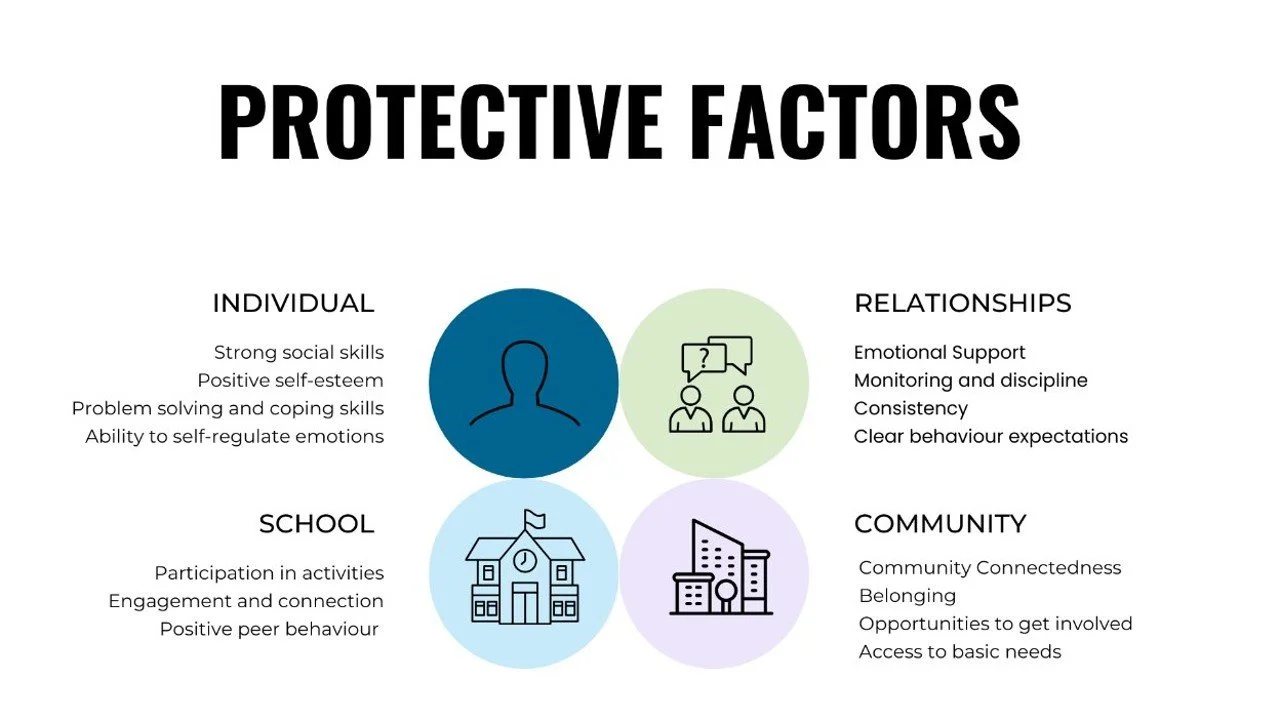
PROTECTIVE FACTORS are conditions or attributes that mitigate or buffer against the effects of risk. Ex.
Emotional Regulation Skills
Positive School Climate
Access to Services
EXTERNAL - Ex. caring adults, peer support, community resources, safe environments
Importantly, resilience is not the absence of distress. It reflects adaptive functioning despite exposure to adversity. This ecological perspective aligns with developmental systems theory, which emphasizes that youth mental health outcomes are shaped by interactions between individuals and their environments (Bronfenbrenner, 1979; Ungar, 2011).

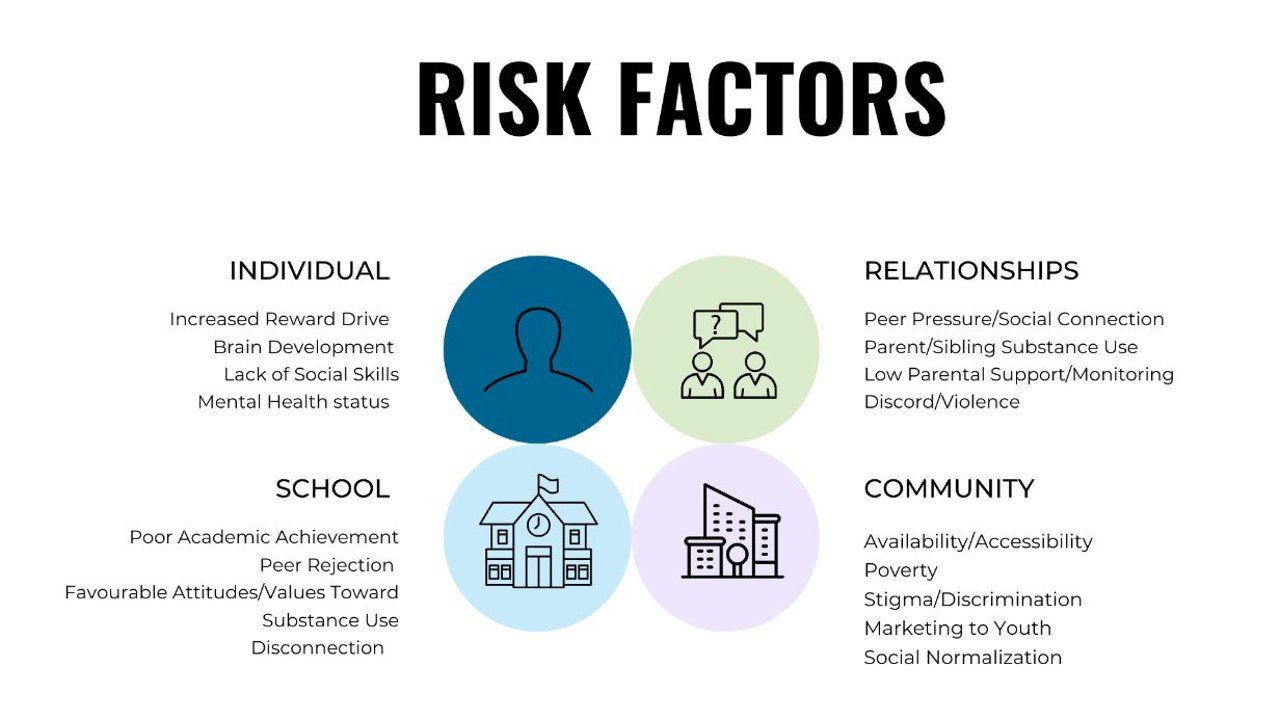
RISK FACTORS are conditions or experiences that increase the likelihood of mental health challenges or substance use problems.
They do not guarantee negative outcomes, but they increase vulnerability. Risk is not located only within the individual. Youth mental health is shaped by multiple interacting systems — individual development, relationships, school environments, and broader community and societal influences.
The greater the number and intensity of risk factors present, particularly in the absence of protective supports, the greater the likelihood of negative mental health outcomes. This is often referred to as cumulative risk.
Supportive Relationships
Risk factors can operate across multiple levels:
Individual Factors
Ongoing brain development, particularly in areas responsible for judgment, planning, and impulse control (continues into the mid-20s)
Heightened emotional reactivity during adolescence
Early exposure to substance use
Pre-existing mental health concerns
Relationship Factors
Peer pressure
Bullying or social exclusion
Family conflict or inconsistent caregiving
Lack of emotional support
School Factors
School disconnection or disengagement
Academic stress without adequate support
Lack of belonging within the school community
Community and Societal Factors
Exposure to trauma or violence
Marketing targeting youth
Stigma related to mental health or substance use
Discrimination based on race, ethnicity, disability, gender identity, sexual orientation, or mental health status
Risk factors are cumulative. The presence of multiple stressors increases overall vulnerability. However, risk does not determine destiny. Outcomes depend on the interaction between risk and protective factors.
While risk factors increase vulnerability, they do not act in isolation. Two youth exposed to similar risks may experience very different outcomes depending on the protective factors present in their lives. Let’s now examine the protective factors that buffer risk and strengthen resilience. We’ve discussed risk factors — the conditions that increase vulnerability to mental health and substance use challenges.
Now we want to focus on protective factors — the conditions that reduce risk or buffer its impact.
PROTECTIVE FACTORS are characteristics, skills, relationships, and environmental supports associated with a lower likelihood of negative mental health outcomes.
They do not eliminate adversity, but they reduce its impact and strengthen resilience. Importantly, protective factors are areas where we often have influence.
Many youth are exposed to significant risk factors such as trauma, abuse, violence, stigma, discrimination, or existing mental health conditions.
The presence of risk does not determine outcomes. Research consistently shows that strong protective factors can buffer even high levels of adversity and improve long-term mental health outcomes. Protective factors operate across systems — individual, relational, school, and community — just like risk factors.
Protective factors may include:
Emotional regulation and coping skills
Problem-solving ability
Supportive relationships with adults and peers
School connectedness
Safe and inclusive environments
Adequate sleep and healthy routines
As educators and peer leaders, we can influence protective factors by:
Teaching coping and emotional regulation skills
Promoting belonging and inclusion
Reducing stigma
Encouraging help-seeking
Strengthening connection to school and community
Mental health and substance use challenges are complex and never caused by a single factor. Two youth with similar risk exposure may have very different outcomes depending on the protective factors present in their lives.
While risk increases vulnerability, protective factors increase capacity. As peer educators and future professionals, our greatest opportunity lies in intentionally strengthening the protective factors within our classrooms, programs, and communities. Next, we will explore how to practically build and reinforce these supports in youth-serving environments.
-
Bronfenbrenner, U. (1979). The ecology of human development. Harvard University Press.
Masten, A. S. (2014). Ordinary magic: Resilience in development. Guilford Press.
Ungar, M. (2011). The social ecology of resilience: Addressing contextual and cultural ambiguity of a nascent construct. American Journal of Orthopsychiatry, 81(1), 1–17.
Arango, C., Dragioti, E., Solmi, F., et al. (2021). Risk and protective factors for mental disorders beyond genetics: An evidence-based atlas. World Psychiatry, 20(3), 417–436.
O’Connell, M. E., Boat, T., & Warner, K. E. (2009). Preventing mental, emotional, and behavioral disorders among young people: Progress and possibilities. National Academies Press.
Public Health Agency of Canada. (2018). The Chief Public Health Officer’s Report on the State of Public Health in Canada 2018.
Youth.gov. (n.d.). Risk and protective factors.
Alegría, M., NeMoyer, A., Falgàs Bagué, I., Wang, Y., & Alvarez, K. (2018). Social determinants of mental health: Where we are and where we need to go. Current Psychiatry Reports, 20, 95.
Arango, C., Dragioti, E., Solmi, F., et al. (2021). Risk and protective factors for mental disorders beyond genetics: An evidence-based atlas. World Psychiatry, 20(3), 417–436. https://doi.org/10.1002/wps.20894
Cleveland, M. J., Feinberg, M. E., Bontempo, D. E., & Greenberg, M. T. (2008). The role of risk and protective factors in substance use across adolescence. Journal of Adolescent Health, 43(2), 157–164.
O’Connell, M. E., Boat, T., & Warner, K. E. (2009). Preventing mental, emotional, and behavioral disorders among young people: Progress and possibilities. National Academies Press.
Public Health Agency of Canada. (2018). The Chief Public Health Officer’s Report on the State of Public Health in Canada 2018.
Youth.gov. (n.d.). Risk and protective factors.